

Broker vs direct lender — which one actually saves you money?
- Real people
- No obligation
- Free to check
- RateSame or better via broker
- ChoiceBroker: 10+; Direct: 1
- FootprintBroker: soft; Direct: often hard
- You pay broker£0 — lender pays

If you've been shopping for car finance for more than an afternoon, you've hit the fork: apply direct to a lender you've heard of, or go through a broker who quotes on your behalf. Both routes are perfectly legitimate. Both are FCA-regulated. And both are set up to make you feel like the other one is a rip-off. This guide is the version we'd give a friend — no team colours, just what changes depending on which door you walk through.
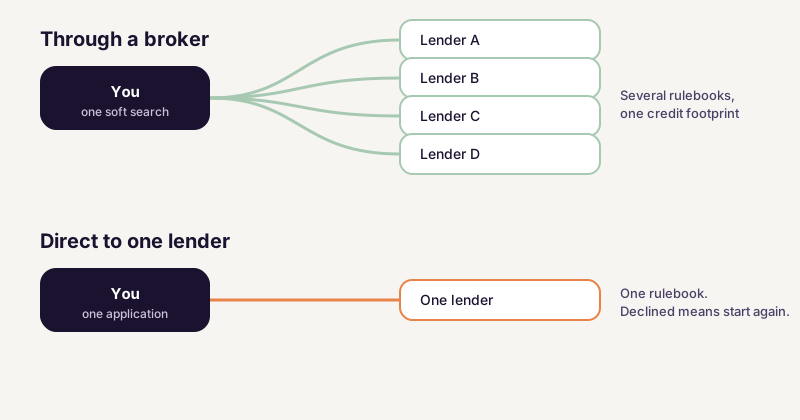
The single biggest thing to understand is that neither route is automatically cheaper. The rate a lender offers depends on their view of your credit profile, not on whether you arrived through their front door or via a broker. A broker's value is not a lower rate on the same lender — it's access to a wider range of lenders in one search, and the ability to route you to the one whose rulebook you actually fit.
The one-sentence definitions
- Definition
- Direct lenderA finance company that underwrites and funds car loans itself, and takes applications on its own website or via a dealer showroom.Examples: Black Horse, Motonovo (via a dealer), Zopa Car Finance, Carmoola. Each has a single set of criteria — score cutoffs, income multiples, employment rules — and every application is judged against that one rulebook.
- Definition
- Credit brokerAn FCA-regulated firm that takes one application from you and matches it to the most suitable lender from a defined panel.A broker isn't a lender. We introduce you to a lender, they pay us commission when a deal completes, and the lender's rate to you is unchanged by that commission. Brokers vary hugely — some have three lenders on panel, others thirty; some specialise in near-prime, others in prime only. Ask which lenders they use before you apply.
Side-by-side comparison
| Broker | Direct lender | |
|---|---|---|
| Applications from you | One | One per lender |
| Credit footprint | Soft search across panel | Often hard search after decision |
| Rate on the same lender | Same | Same |
| Choice of lender | Panel (typically 5 – 30) | That lender only |
| What happens if declined | Broker tries the next fit | You start again elsewhere |
| Speed on prime credit | Similar (minutes to hours) | Fastest — sometimes seconds |
| Speed on imperfect credit | Faster — right lender first time | Slow — multiple rejections |
| You pay them directly | £0 | £0 |
| Commission disclosed | Yes, before you sign | N/A — no intermediary |
When direct is genuinely the better route
If you have a clean, prime credit file — long-standing electoral roll, no missed payments in six years, a steady employed income, and you already bank with a mainstream provider — going direct to a lender you know can be the fastest and simplest path. You already know they'll say yes; the broker layer adds nothing. Personal loan rates from your existing bank can occasionally undercut car finance rates for prime borrowers, particularly on small amounts under £7,500 where personal loan pricing is most competitive.
Direct is also the right shape if you're buying from a dealer whose in-house finance offer is genuinely subsidised — 0% or heavily discounted (Annual Percentage Rate — the yearly cost of borrowing including interest and standard fees, used to compare finance offers on a like-for-like basis.) promotions on new cars, usually manufacturer-backed. These are real, and no broker can beat them because the manufacturer is paying down the rate. The rule of thumb: if the APR looks too good, check whether it's a manufacturer promotion tied to that specific vehicle and stock — if it is, take it.
When a broker is doing real work for you
Almost everywhere else, the broker route wins on maths, footprint or both. Here's why — and the pattern is the same whether we're talking about our panel or any competent broker's.
- Imperfect credit — one CCJ, one missed payment, or a thin file after a period abroad. Direct lenders decline on hard rules; specialist lenders on our panel look at the underlying story and often approve. One soft search finds them.
- Self-employed or new-to-role income. Prime direct lenders want 12–24 months of P60s; specialist lenders accept SA302s, three months of business bank statements, or a signed accountant's letter. A broker knows which lender accepts which document set today, not last year.
- You want the option to compare HP against PCP on the same car. A broker can quote both structures across multiple lenders in one search. Direct lenders usually quote whichever product they specialise in.
- You've already been declined once and want the next step without a second hard footprint. Multiple hard searches within a short window can pull your credit score down further — a soft search across a panel avoids that entirely.
- You're financing an older vehicle, a van, an import, or a high-mileage car. Vehicle-age and mileage rules vary sharply between lenders; a broker filters your car against panel eligibility before the application even goes out.
The commission question, answered plainly
The most common worry: 'if a broker is paid by the lender, aren't they steering me to whoever pays them most?' Since January 2021, the FCA has banned the model that created that incentive — discretionary commission, where a broker earned more by arranging a higher interest rate on your deal. Under the current rules, our commission is a fixed fee or a fixed percentage agreed in advance with each lender. It doesn't move with your rate. It also has to be disclosed to you, in £ terms, before you sign the agreement.
What the same profile looks like on both routes
To make this concrete, consider a driver with a fair-but-not-perfect credit file — one 90-day missed credit card payment 18 months ago, everything else clean, employed for four years on a £34,000 salary, £2,500 deposit, looking at a £14,000 used car. On a prime direct lender's website that missed payment is likely to trigger an automatic decline before a human sees it. The (A credit check recorded on your file that other lenders can see. Multiple hard searches in a short window can lower your score.) stays visible for two years.
The same profile submitted through a broker triggers a (A credit check that doesn't leave a visible footprint on your credit file for other lenders to see.) across a panel. Prime lenders decline instantly, which is fine — no footprint. Two near-prime lenders (specialists in exactly this shape of file) return provisional yeses around 10.9% – 14.9% APR. The broker walks the driver through both quotes, and the customer picks the one with the term and monthly payment they prefer. Same driver, same car — very different journey. This is the pattern we see every working day.
- Prime direct (declined)0 £/mo
- Near-prime lender A — 12.9% APR305 £/mo
- Near-prime lender B — 14.9% APR316 £/mo
The five questions to ask any broker
- How many lenders are on your panel, and who are they? A good broker will name at least the top five without hesitation.
- Is your eligibility check a soft search? It should be — anything else costs you a footprint before you've committed.
- How is your commission structured on my agreement — fixed fee, percentage, or a combination? What £ figure will appear on my pre-contract information?
- Are you a directly authorised firm or an Appointed Representative? Both are fine; you just want to know their FCA status.
- If I'm not accepted today, what happens — do you keep my file open, or do I need to reapply later?
The 60-second decision framework
Take a broker route if any of these are true: your credit file has any complication (missed payments, CCJs, defaults, short UK residency, thin file), your income is anything other than PAYE with 12+ months at your current employer, you want to compare (A car finance product where you pay a fixed monthly amount and own the car outright at the end of the term.) and (A car finance product with lower monthly payments and a large optional final payment (the balloon) if you want to keep the car.), or you've already been declined once elsewhere. Take the direct route if you're a prime borrower with a specific lender in mind and a specific vehicle offer that's manufacturer-subsidised. Everywhere in between, a broker's panel almost always wins because it converts one soft search into up to thirty parallel decisions.
Neither route is a hack. Both are perfectly legitimate ways to get from wanting a car to driving one. The mistake is picking on the wrong axis — 'brokers are dodgy', 'direct is always cheaper' — rather than on the shape of your own credit file and how much choice you actually want.
Sources
- Financial Conduct Authority · PS20/8: Motor finance discretionary commission ban · 1 July 2020
- Financial Conduct Authority · Consumer Credit Sourcebook (CONC) · 1 April 2024
- Financial Conduct Authority · Financial Services Register · 1 January 2025
- Finance & Leasing Association · Choosing a car finance provider · 1 June 2024
- MoneyHelper · Different ways to finance a car · 1 September 2024
Common questions
Does a broker charge me a fee?
Not at WeCarFinance, and not at any FCA-authorised broker who's transparent about their model. We're paid by the lender when your finance completes. Anyone charging you an upfront broker fee before an agreement is signed is a red flag — always check them on the FCA Register first.Will using a broker hurt my credit score?
No — the eligibility check is a soft search, which is only visible to you, not to other lenders. A hard search happens only once you've picked a lender's offer and asked us to proceed to a formal application.Are the rates I'm offered through a broker higher than going direct?
No — the rate a specific lender offers you is set by their underwriting model, not by whether you arrived directly or via a broker. Our commission comes from the lender, not from a rate uplift.Can I apply to a broker and a direct lender at the same time?
Technically yes, but it's rarely a good idea. Multiple hard searches within a short window can knock your credit score down. A single soft search through a broker sees which lenders will approve you without any footprint at all.How many lenders should a broker have on panel?
There's no magic number, but fewer than five suggests limited choice, and more than about thirty suggests they're chasing volume over fit. What matters more is that the panel covers the credit tier you're actually in — prime, near-prime or specialist.
Check what you'd be offered.
Real people, straight answers. Talk to us before you apply if you want to.
People also ask
What's the difference between an eligibility check and a full application?
An eligibility check gives an early indication of the deals you are likely to qualify for based on limited information. A full application happens once you've chosen a vehicle and involves the lender running a complete underwriting assessment before issuing a formal offer. Ask any lender directly how each type of check is recorded on your credit file, since practice varies.
How long does the whole process usually take?
Timeframes vary by lender, but many customers get an initial decision within a day and complete the full process, from choosing a vehicle to collection or delivery, within a week or two, depending on how quickly paperwork and vehicle preparation are completed.
Will a soft search show up on my file when a lender assesses a later application?
No. Soft searches appear only on the version of your file that you can see. Lenders assessing a new application do not see soft searches carried out by other organisations.
From Soft vs hard credit search — what each one really does to your file
How many hard searches is too many?
There's no fixed number, but credit reference agencies generally treat one or two hard searches, spread out, as routine. A cluster of four or more in a short period is more likely to draw scrutiny from underwriters.
From Soft vs hard credit search — what each one really does to your file
Related reading

How car finance works
A clear guide to HP, PCP and leasing, eligibility checks, deposits and what happens after you apply for car finance in the UK.

Soft vs hard credit search — what each one really does to your file
What soft and hard credit searches are, who can see them, how many hard searches is too many, and how to check your own credit file for free.

How to improve your chances of car finance acceptance
Practical UK steps that strengthen a car finance application: electoral roll, utilisation, disputes, and timing your enquiries sensibly.