

How long should I wait to reapply after a car finance decline?
- Real people
- No obligation
- Free to check
- Formal waiting ruleNone set by CRAs or the FCA
- Data-error fixesCan often reapply within days
- Affordability declinesAround 2–3 months is sensible
- Hard search visibilityUp to 12 months on your file

If you've just been turned down for car finance, the instinct is often to try again straight away, or to try a few different lenders in the same afternoon and see what sticks. Neither credit reference agencies nor the Financial Conduct Authority set a fixed number of days you have to wait before reapplying. There's no rule that locks you out. But that doesn't mean timing is irrelevant — it just means the relevant clock isn't a countdown, it's the state of your credit file and finances at the moment you apply again. It's worth remembering, too, that a decline is a snapshot judgement made at one point in time by one lender, using the information available to them that day. It isn't a permanent label, and it doesn't mean every other lender will reach the same conclusion using the same information. Treating a single decline as final, or treating it as something to brute-force with repeated applications, are both understandable reactions — but neither reflects how lending decisions or credit files actually work in practice.
Every full application usually triggers what's known as a (A credit check recorded on your file that other lenders can see. Multiple hard searches in a short window can lower your score.), and each one is visible to other lenders for a period of time. Several hard searches placed close together can make a file look more stretched to an underwriter, even if nothing else about your circumstances has changed. This guide sets out what actually changes on your file over time, how long different types of decline typically take to work through, and what's worth doing in the meantime rather than simply waiting. Knowing the difference between a search that leaves a visible mark and one that doesn't is one of the most useful pieces of information you can have before you reapply, because it changes how you go about finding out whether you're likely to be accepted next time round.
What a decline usually means
A decline is a lender's decision that, based on the information it saw, it wasn't willing to offer finance on the terms you applied for. That's it — it isn't a verdict on your overall financial character, and it doesn't automatically follow you from lender to lender in some shared blacklist. Lenders set their own lending criteria and risk appetite, and two lenders can reach different conclusions from the same information. Understanding why a particular lender said no is more useful than assuming every lender will say the same thing. Lenders assess a combination of factors: your credit history, your income and outgoings, the amount and term you're applying for, and their own internal risk appetite at that particular time. A lender that has recently tightened its criteria in a particular area, for instance, might decline applications it would have approved a few months earlier, entirely independently of anything about you personally. This is one reason a decline from one lender isn't necessarily predictive of how a different lender, with a different risk model, will respond to the same application.
- Definition
- Reapplication windowThe period after a decline during which reapplying is unlikely to change the outcome because nothing material on your file has changed yet.There's no legally defined window. How long it takes to close depends entirely on the reason for the decline — a data error can be corrected in days, while a default or missed payment needs time to age on your credit report before it carries less weight.
How long to wait, by decline reason
The sensible wait time depends heavily on why you were declined. A mismatch between the address on your application and the one held by the credit reference agencies can sometimes be resolved the same day. An affordability decline, where a lender judged your income didn't comfortably cover the repayment alongside your other commitments, generally needs a fresh run of bank statements to look different. A missed payment or default needs time to age before it carries less weight in a lender's assessment.
| Decline reason | Typical wait before reapplying | What tends to help | Where to check |
|---|---|---|---|
| Data mismatch (address, name, employer) | Once corrected, often within days | Update electoral roll and personal details | GOV.UK, credit reference agencies |
| Affordability concerns | Around 2–3 months | Reduce non-essential spending, settle short-term debt | MoneyHelper budgeting tools |
| Recent missed payment | Several months | Consistent on-time payments going forward | Your credit report |
| Default recorded recently | Often a year or more | Time to age, plus settling the debt if possible | Credit reference agency report |
| Multiple recent hard searches | A few months | Avoid further applications until the search count reduces | Credit reference agency report |
| Little or no credit history | Varies — often 1–2 months | Build a short, modest track record first | MoneyHelper guide to credit scores |
What actually changes on your file over time
Rather than thinking of your credit file as a single score that ticks upward day by day, it helps to think of it as a set of separate records, each with its own visibility period. Once you know roughly how long each type of record stays visible and how its weight tends to fade, the logic behind waiting becomes clearer.
- Hard searches: according to Experian, these are typically visible to other lenders for around 12 months, though how much weight a lender gives an older search varies by lender.
- Missed payments: reported monthly and can remain on file for up to six years, though their significance usually reduces the further away they are and the more recent, on-time payments you've made since.
- Defaults: Equifax notes that a default stays on file for six years from the date it was recorded, regardless of whether it's later settled.
- County Court Judgments (CCJs): also generally stay on file for six years from the judgment date; the Register of Judgments notes that a CCJ paid in full within one month of the judgment can be removed from the public register.
- Bankruptcy and IVAs: these typically remain on file for six years from the date of the order.
- Electoral roll registration: GOV.UK confirms you can register to vote, and being correctly registered at your current address is one of the checks lenders commonly use to confirm identity.
- Hard search12 months
- Missed payment72 months
- Default72 months
- CCJ72 months
- Bankruptcy/IVA72 months
Why several quick applications can work against you
A single decline doesn't tell the next lender much on its own. But a cluster of hard searches within a short window can suggest to an underwriter that several lenders in a row have declined the same applicant, even if that's not exactly what happened. This is sometimes called credit-hungry behaviour, and it's one of the reasons lenders look at not just whether you have debt, but how you've been applying for it recently.
Affordability declines versus credit history declines
It helps to separate two broad categories of decline, because the fix for each is different. The first is an affordability decline, where a lender concludes that the repayment wouldn't comfortably fit alongside your existing income and outgoings. This kind of decision is usually based on recent bank statements and declared income, rather than on your long-term credit history. The second is a credit history decline, where the lender's concern is based on how you've managed credit in the past — missed payments, high balances, or a default, for example.
The reason this distinction matters is that the waiting period genuinely does different work in each case. For an affordability decline, waiting gives you time to accumulate a fresh set of bank statements that look different — ideally with lower discretionary spending, fewer short-term credit transactions, and a clearer picture of disposable income. For a credit history decline, waiting mostly gives existing negative entries time to age and lose weight, while new positive history — on-time payments, lower balances — has time to build up alongside them. Neither type of decline is fixed simply by the passage of time on its own; both need something to actually change during that period.
What to do in the waiting period, rather than nothing
- Get your credit reports from the main credit reference agencies and check them line by line for errors — wrong addresses, accounts that should be closed, or entries that don't belong to you.
- If you find an error, raise a dispute with the credit reference agency and the lender that reported it. The Information Commissioner's Office sets out your rights over inaccurate personal data.
- Register on the electoral roll at your current address if you haven't already — this is a quick, factual fix that many lenders check.
- Bring down balances on credit cards and overdrafts where you can; how much of your available credit you're using is a factor many lenders weigh.
- Let at least one full statement cycle pass on your active accounts, so your most recent activity looks different from when you were declined.
- Keep proof of income and address ready — recent payslips, a tenancy agreement or utility bill — so a future application can be assessed with fewer follow-up questions.
A worked example
Imagine someone applies to one lender, is declined, and then applies to two more lenders over the following two days because the first decline felt discouraging and they wanted a quick answer. Within under a week, their file now shows three hard searches close together. Even if none of those lenders would otherwise have been put off, the pattern itself can raise questions for whichever lender looks at the file next.
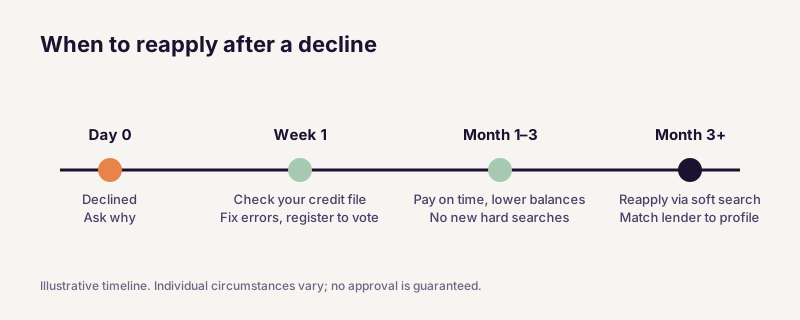
A more measured approach would be: decline on day one, spend the following weeks checking the credit report for errors, correcting anything wrong, reducing card balances, and registering on the electoral roll if needed. A fresh application some weeks later, once those changes have had time to be reflected, is likely to be assessed on a materially different — and often stronger — picture.
When the honest answer is to wait longer
Sometimes there's genuinely no quick fix. A default recorded in the last few months, a recent (County Court Judgment — a court ruling that you owe a debt. Sits on your credit file for six years unless settled within a month.), or a recent bankruptcy discharge are the kind of events that many mainstream lenders will weigh heavily for some time regardless of what else you do. In these cases, some lenders specialise in assessing applicants with a more complex credit history, but even then, allowing an adverse event to age generally improves how it's viewed. There's no shortcut that makes a recent default look like an old one.
It's also worth remembering that every lender sets its own criteria, so a timeframe that works for one lender may not be enough for another. If your situation is complicated — several credit issues at once, self-employment income, or a recent house move — it can be worth talking through your options before applying again, rather than guessing.
Getting a clearer picture before you reapply
Before submitting another full application, it's worth being honest with yourself about what's actually changed since the decline. If the answer is 'nothing yet', that's a useful signal to spend a little more time on the fixes above rather than applying again straight away. If something has genuinely shifted — an error corrected, a card balance cleared, three fresh months of stronger bank statements — then a further application is likely to be assessed on a different basis than the one that led to the original decline.
It's also sensible to think about which lender or type of lender you approach next. Some lenders specialise in more complex credit profiles and weigh recent history differently from high-street providers. Comparing your options with someone who can explain how different lenders typically treat different circumstances, rather than applying to whichever lender is most visible online, can reduce the number of applications you need to make overall.
Sources
- Financial Conduct Authority · Consumer Credit sourcebook (CONC) · 1 January 2026
- MoneyHelper · How to check your credit report · 1 June 2025
- MoneyHelper · What is a credit score and how is it calculated? · 1 June 2025
- Experian · How long do things stay on your credit report? · 1 March 2025
- Equifax · How long does information stay on my credit report? · 1 February 2025
- GOV.UK · Register to vote · 1 April 2025
- Information Commissioner's Office · Your right to get inaccurate personal data corrected · 1 May 2025
- GOV.UK · Register of Judgments, Orders and Fines · 1 July 2025
Common questions
Is there a legal waiting period after a car finance decline?
No. Neither the credit reference agencies nor the FCA set a mandatory waiting period. What matters is whether your circumstances or credit file have genuinely changed since the decline.Will checking my own credit report count against me?
No. Checking your own report is a soft search and isn't visible to lenders or reflected in how your file is scored. It's a sensible first step after any decline.How many hard searches is too many?
There's no fixed cut-off, but several hard searches within a short space of time can look like credit-hungry behaviour to some lenders. Spacing applications out and checking eligibility criteria beforehand can reduce this risk.Does reapplying to the same lender ever work?
It can, but usually only if something specific has changed — an error has been corrected, your income has increased, or the lender's own criteria have shifted. Otherwise, the same decision is likely to be reached again.What should I check first after a decline?
Start with your credit reports from the main credit reference agencies. Look for errors, out-of-date information, or accounts that shouldn't be there, and raise a dispute if you find any.Does a default mean I can never get car finance again?
No, but a recent default is likely to be weighed heavily by many mainstream lenders for some time. Its impact generally reduces as it ages, and some lenders assess applicants with a more complex credit history differently.
Check what you'd be offered.
Real people, straight answers. Talk to us before you apply if you want to.
People also ask
Will a soft search show up on my file when a lender assesses a later application?
No. Soft searches appear only on the version of your file that you can see. Lenders assessing a new application do not see soft searches carried out by other organisations.
From Soft vs hard credit search — what each one really does to your file
How quickly can changes to my credit file show up?
An electoral roll update usually takes a few weeks. A lower credit-card balance shows on your next statement. A disputed entry can take up to 28 days to resolve under the standard correction process. None of these are instant.
Does closing an old credit card help?
Usually not. Closing an account shortens your visible credit history and can raise your utilisation on the accounts that remain. It is generally better to keep old accounts open and lightly used.
Related reading

Soft vs hard credit search — what each one really does to your file
What soft and hard credit searches are, who can see them, how many hard searches is too many, and how to check your own credit file for free.

How to improve your chances of car finance acceptance
Practical UK steps that strengthen a car finance application: electoral roll, utilisation, disputes, and timing your enquiries sensibly.

Broker vs direct lender — which actually saves you money?
An honest comparison of using a car finance broker vs applying direct to a lender: rate, choice, footprint, commission and speed — with real UK examples.