

Commission and your car finance deal — who pays whom, and why
- Real people
- No obligation
- Free to check
- Who pays the introducerThe lender, not you
- Rate-linked commissionBanned since January 2021
- Disclosure requirementIn £ terms, before signing
- Where to checkYour pre-contract credit information
Editorial attribution and review details are being checked.
Commission is one of the least understood parts of buying a car on finance, and it's also one of the most scrutinised. Brokers and dealer finance desks are paid by lenders for introducing customers, in much the same way a mortgage broker or an insurance broker is paid. That model is legal and long-standing. What changed is how that commission can be structured, following a Financial Conduct Authority intervention that took effect in January 2021 and that is still generating consumer complaints and regulatory activity today. This page explains who pays whom, what the FCA banned, and what you're entitled to ask about the commission on your own agreement.
Start with the basic point: you do not hand money to a broker for arranging your finance. The broker or dealer is paid by the lender once your agreement completes. Your interest rate is set by the lender's own underwriting and pricing, based on your credit profile, income and the loan you're asking for — not chosen by the broker. That has always been true. What the FCA changed in 2021 was narrower but important: it stopped brokers and dealers being able to increase their own pay by placing you on a higher rate.
A quick definition
- Definition
- Commission (motor finance)A payment a lender makes to a broker or dealer for introducing a customer whose finance agreement goes ahead.In UK motor finance this is paid by the lender, not the customer. It's typically a fixed fee or a fixed percentage of the amount financed, agreed between the lender and the introducer in advance. Under FCA rules it must be disclosed to the customer, and since January 2021 it cannot be structured so that it rises with the interest rate you're charged.
Who pays whom on a typical agreement
The money flow on a standard car finance deal is more straightforward than it sounds. The lender pays the dealer for the car (or advances that amount on your behalf). You repay the lender in instalments over the agreed term. Somewhere in that chain, the lender also pays a commission to whoever introduced the business — a broker, or the dealership's own finance team. That payment comes out of the lender's margin on the deal; it isn't a separate charge added to your monthly payment.
| Party | Pays | To | For |
|---|---|---|---|
| You | Deposit and monthly payments | Lender | Repaying the amount financed |
| Lender | Price of the car (less deposit) | Dealer | Purchase of the vehicle |
| Lender | A fixed fee or fixed % of the amount financed | Broker or dealer finance desk | Introducing the customer |
| Broker | Nothing | You | The introduction service is not charged to you directly |
| Dealer | n/a | You | Any add-ons such as warranty or GAP insurance are separate and optional |
What the FCA banned in January 2021
Before 2021, many motor finance commission arrangements were what the FCA called discretionary commission models. Within limits set by the lender, the broker or dealer could choose the interest rate offered to a customer — and the higher the rate, the more commission they earned. That created an incentive to charge some customers more than their credit profile justified, with no benefit to the customer in return.
Policy Statement PS20/8 banned discretionary commission models with effect from 28 January 2021. Since then, commission in UK motor finance has had to be structured so it does not vary with the interest rate on the agreement — typically a flat fee, or a fixed percentage of the amount financed, agreed between lender and introducer before the sale. Disclosure obligations around commission are set out in the FCA's Consumer Credit Sourcebook (CONC), and commission still has to be disclosed to the customer as part of the pre-contract information.
- Fixed fee (illustrative)200 £
- 1.5% of amount financed210 £
- 3% of amount financed420 £
What commission does not do
Since the 2021 ban, commission cannot legally add to your monthly payment by being linked to your rate, and it isn't a hidden charge billed back to you separately. It's treated by the lender as a cost of acquiring the customer, similar to any other marketing or origination cost, and it's built into how the lender prices its overall book rather than into your individual rate. Your rate itself is set by the lender's underwriting on your application — income, credit history, the loan amount and term — the same inputs that would apply if you approached that lender directly.
This is worth spelling out because it's counter-intuitive: going through a broker does not, by itself, make your finance more expensive than applying to the same lender directly. The commission the introducer earns is separate from your rate and does not get layered on top of it under current rules.
Illustrative worked example
This is a hypothetical example to show the shape of the numbers — it is not a quote and your own terms will differ. Suppose a customer buys a used car priced at £16,500 with a £2,500 deposit, financing £14,000 over 48 months on a (A car finance product where you pay a fixed monthly amount and own the car outright at the end of the term.) agreement, with an example (Annual Percentage Rate — the yearly cost of borrowing including interest and standard fees, used to compare finance offers on a like-for-like basis.) of 12.9%. Using standard monthly amortisation, the repayments work out at roughly £370 a month, with a total repayable of around £17,760 over the term — that's about £3,760 in interest across four years. On this illustrative agreement, an introducer might earn a fixed fee of around £200 or a fee calculated as a fixed percentage of the amount financed. Neither figure changes if the customer's rate had been higher or lower, and neither is added to the monthly payment shown above — both would be disclosed to the customer in pound terms in the pre-contract information before signing.
Questions worth asking before you sign
- Check the firm is listed on the FCA Financial Services Register at register.fca.org.uk before you deal with them.
- Ask whether commission on your agreement is a fixed fee or a percentage of the amount financed, and ask for the figure in pounds.
- Ask directly whether the commission changes if your interest rate is higher or lower — under current rules it should not.
- Read the pre-contract information in full: amount financed, APR, total amount payable, and any commission disclosure.
- Be cautious of anyone asking for payment upfront before an agreement is arranged — that isn't how commission-funded introduction normally works.
Why the ban happened
The FCA reviewed the motor finance market and found that discretionary commission arrangements, where brokers and dealers could set the customer's rate within a range and earn more commission for a higher rate, gave introducers a financial incentive that worked against the customer's interest. That review led directly to Policy Statement PS20/8 and the ban that took effect in January 2021. You can read the FCA's own summary of the policy change and its reasoning on the FCA website (see sources below).
The ban did not remove commission from the market — introducers are still paid for the work of packaging an application and connecting a customer with a lender that can consider them. What changed is the link between that payment and the price the customer pays. Since 2021, the introducer's commission is fixed in advance and does not move if the customer ends up on a higher or lower rate.
What the Financial Ombudsman complaints are about
Since around 2023, the (The free, independent dispute-resolution service for regulated financial products in the UK. You don't need a claims company to use it.) has dealt with a substantial number of complaints from customers who took out motor finance under the old discretionary commission model, before the January 2021 ban applied. Those complaints are assessed against the rules in force at the time the agreement was arranged. If you think you were affected by a (A now-banned commission model where brokers could raise a customer's interest rate to earn more commission. Central to the FCA motor finance redress scheme.) on an older agreement, the Financial Ombudsman Service and the FCA both publish guidance on how to check and how to complain — see the sources below. For agreements taken out after January 2021, the discretionary model is no longer permitted, so the underlying issue does not apply in the same way.
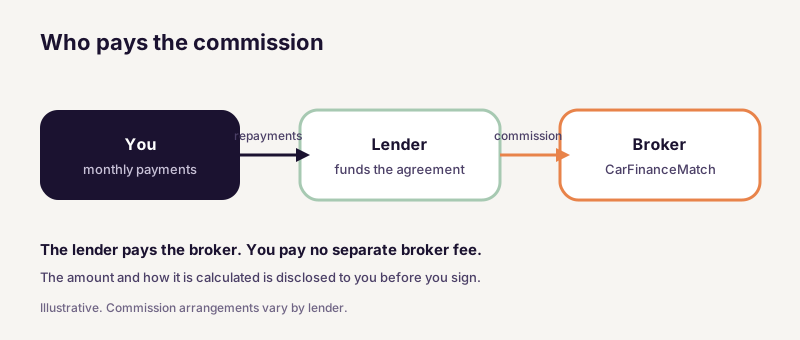
If you're arranging car finance now, the practical takeaways are simple. Commission exists and is a normal part of how brokers and dealer finance desks are paid. It comes from the lender, not from you directly. It has to be disclosed to you in pound terms before you sign. And under current FCA rules it should not move in step with the interest rate you're offered. If any of those points aren't answered clearly, that's a reasonable moment to ask more questions or look elsewhere.
How this compares with other types of credit broking
Commission-funded introduction isn't unique to car finance. Mortgage brokers, some insurance brokers and many personal loan comparison services work the same way: the customer doesn't pay a fee, and the firm arranging the deal is paid by the product provider once the sale completes. Car finance has had extra regulatory attention because of the specific discretionary commission problem identified by the FCA, but the underlying business model — provider pays the introducer, customer pays the provider — is common across regulated consumer credit.
One difference worth noting is that a car finance broker or dealer typically only has relationships with a limited number of lenders, not the whole market. That doesn't affect how commission works, but it does mean the rate and terms you're offered through any single introducer reflect the lenders they can place your application with, rather than every lender that exists. Asking how many lenders a broker works with, alongside asking about commission, gives you a fuller picture of what you're being offered.
What to do if you're not satisfied with an answer on commission
If a broker or dealer won't tell you whether their commission is a fixed fee or a percentage, won't put a figure on it, or gives you an answer that doesn't match what's in the pre-contract paperwork, you have a few options. You can ask again in writing and request the answer is put in your file. You can check the firm's status on the FCA Financial Services Register. And if you go ahead with an agreement and later believe the commission wasn't properly disclosed, you can complain to the lender first, then escalate to the Financial Ombudsman Service if the response doesn't resolve things.
It's also worth knowing that any personal data you provide as part of a finance application is subject to UK data protection law, and firms handling it have obligations under the UK GDPR and Data Protection Act 2018, overseen by the Information Commissioner's Office. That's separate from the commission question, but it's part of the same broader picture of what a regulated firm has to get right before, during and after arranging your finance.
A note on leasing and other agreement types
The commission principles described here apply most directly to regulated hire purchase and (A car finance product with lower monthly payments and a large optional final payment (the balloon) if you want to keep the car.) agreements, which are the most common ways of financing a car in the UK. Leasing arrangements such as personal contract hire can also involve commission paid to a broker or dealer by the leasing company, and industry bodies such as the British Vehicle Rental and Leasing Association publish guidance for consumers on what to expect from a leasing agreement, including costs and charges that sit outside the finance itself.
Sources
- Financial Conduct Authority · PS20/8: Motor finance discretionary commission models and consumer credit commission disclosure · 1 July 2020
- Financial Conduct Authority · Consumer Credit Sourcebook (CONC) 4.5 — commission disclosure · 1 April 2024
- Financial Conduct Authority · Financial Services Register · 1 January 2025
- Financial Ombudsman Service · Car finance and commission complaints · 1 June 2024
- MoneyHelper · Different ways to finance a car · 1 September 2024
- GOV.UK · Consumer Credit Act 1974 · 1 January 2024
- BVRLA · Consumer guidance on vehicle leasing · 1 May 2024
- Information Commissioner's Office · Data protection and your rights · 1 March 2024
Common questions
Do I pay the broker or dealer directly for arranging my finance?
No. The broker or dealer finance desk is paid a commission by the lender once your agreement completes. You aren't billed for that separately.Does commission change the interest rate I'm offered?
It shouldn't. Since January 2021 the FCA has banned commission structures that rise with the interest rate on your agreement. Your rate should be based on the lender's underwriting of your application, not on what the introducer earns.Where can I see the commission on my own agreement?
It should appear in your pre-contract credit information, sometimes called the SECCI, alongside the amount financed, APR and total amount payable. Ask for it in writing if it isn't clear.Do dealership finance desks get paid commission too, not just brokers?
Yes. A dealer's finance desk is introducing you to a lender in the same way a broker does, and the same disclosure rules and the same ban on rate-linked commission apply.I think I was affected by a discretionary commission agreement from before 2021 — what can I do?
You can raise a complaint with the lender first, and if you're not satisfied with the response, refer it to the Financial Ombudsman Service, which publishes guidance specifically on motor finance commission complaints.Is commission illegal or something to be suspicious of?
No. Commission-funded introduction is a standard and legal model in UK consumer finance. What matters is that it's disclosed to you clearly and that it doesn't move with the rate you're offered — both of which are now regulatory requirements.
Check what you'd be offered.
Real people, straight answers. Talk to us before you apply if you want to.
People also ask
What's the difference between an eligibility check and a full application?
An eligibility check gives an early indication of the deals you are likely to qualify for based on limited information. A full application happens once you've chosen a vehicle and involves the lender running a complete underwriting assessment before issuing a formal offer. Ask any lender directly how each type of check is recorded on your credit file, since practice varies.
How long does the whole process usually take?
Timeframes vary by lender, but many customers get an initial decision within a day and complete the full process, from choosing a vehicle to collection or delivery, within a week or two, depending on how quickly paperwork and vehicle preparation are completed.
Can I switch from PCP to HP part way through an agreement?
Not directly — you would need to settle the existing PCP agreement, which means paying the early settlement figure, and then start a fresh HP agreement, potentially on the same car if the lender agrees to a sale, or on a different one. Ask for a current settlement figure before assuming a switch is worthwhile.
What happens if I go over the mileage limit on PCP?
An excess-mileage charge applies, calculated at the pence-per-mile rate stated in your agreement. It is only charged if you hand the car back at the end of the term; it does not apply if you pay the balloon and keep the car.
Related reading

How car finance works
A clear guide to HP, PCP and leasing, eligibility checks, deposits and what happens after you apply for car finance in the UK.

HP vs PCP — which suits you?
Compare Hire Purchase and PCP: monthly cost, mileage limits, ownership and total cost, with a worked illustrative example and a simple decision framework.

How to improve your chances of car finance acceptance
Practical UK steps that strengthen a car finance application: electoral roll, utilisation, disputes, and timing your enquiries sensibly.