

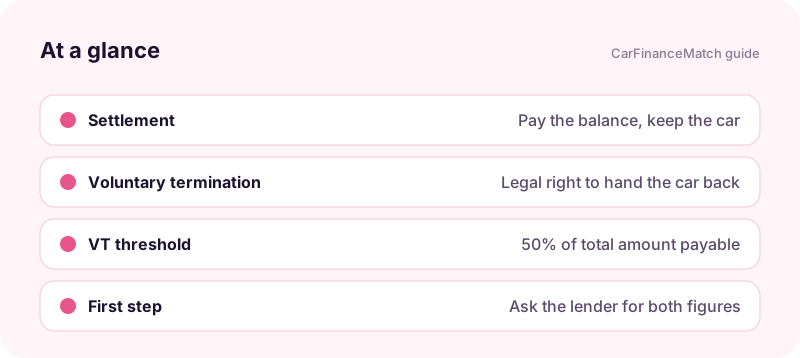
- SettlementPay the balance, keep the car
- Voluntary terminationLegal right to hand the car back
- VT threshold50% of total amount payable
- First stepAsk the lender for both figures
Life changes. A car that fitted your budget two years ago might not fit it now, or you might simply want out of the agreement. If you are on (You repay the full price in instalments, usually after a deposit. The car becomes yours once the last payment and any fee are made.), you are not stuck until the final payment: there are two main ways to end things early, and they lead to very different outcomes.
The first is early settlement, where you pay off what you owe and the car becomes yours. The second is (Your Consumer Credit Act right to end an HP or PCP agreement and return the car once half the total amount payable has been paid.), a legal right under the Consumer Credit Act 1974 that lets you hand the car back once you have paid at least half of the total amount payable. This guide walks through both, what each one costs, and how to work out which fits your situation.
- Definition
- Voluntary terminationA legal right to end a regulated HP or PCP agreement by returning the car, once you have paid at least 50% of the total amount payable, including interest and fees.It comes from section 99 of the Consumer Credit Act 1974. It is not the same as voluntary surrender, where the lender can still chase the shortfall after selling the car. With voluntary termination, your liability is capped at half the total amount payable, plus any arrears and reasonable charges for damage beyond fair wear and tear.
Option one: early settlement
Early settlement means asking your lender for a settlement figure, paying it, and ending the agreement. Because HP spreads the full cost of the car plus interest over the term, the settlement figure is roughly what is left of that, minus a rebate of the interest you will no longer pay. Once it is paid, the car is yours outright.
Settlement tends to make sense when the car is worth more than the settlement figure. In that position you can settle, then sell or part-exchange the car and keep the difference. It can also suit you if you simply want to own the car free of finance and stop the monthly payments.
Option two: voluntary termination
Voluntary termination lets you end the agreement and return the car. The key number is half of the total amount payable, which is the figure shown on your agreement and includes the deposit, all monthly payments, interest and any fees. If you have already paid half, you can terminate and owe nothing further beyond arrears and fair charges. If you have paid less than half, you can still terminate by paying the difference up to that halfway point.
On HP, the halfway point arrives around the middle of the term because there is no large final payment. That makes voluntary termination a realistic exit on HP much earlier than many people expect. On (Monthly payments cover part of the price; the rest sits in an optional final payment you can pay, swap or hand the car back instead.) the (The large optional sum due at the end of a PCP. Paying it means you keep the car; you can usually return the car instead.) sits inside the total amount payable, so the halfway point comes much later.
- Total payable12,000 £
- 50% VT point6,000 £
- Paid after 18 of 48 months4,500 £
- Top-up to VT1,500 £
Side by side
| Question | Early settlement | Voluntary termination |
|---|---|---|
| Do you keep the car? | Yes, it becomes yours | No, you hand it back |
| What do you pay? | The settlement figure | Up to 50% of the total payable, plus arrears and fair charges |
| When does it suit? | Car worth more than you owe, or you want to own it | Car worth less than you owe, or payments no longer fit |
| Credit file effect | None beyond the account closing | The account closes; termination itself is not a default |
| Can the lender refuse? | No, you have a right to a settlement figure | No, it is a legal right on regulated agreements |
What voluntary termination is not
Voluntary termination is often confused with voluntary surrender, and the difference matters. With surrender, you give the car back but the lender sells it and can pursue you for any shortfall between the sale price and what you owe, plus costs. With termination, your liability is capped by law at half the total amount payable. If you write to your lender, use the words voluntary termination and cite section 99 of the Consumer Credit Act 1974 so there is no confusion about which route you are taking.
The condition question
Whichever route you take, the car's condition matters. With settlement it affects what you can sell the car for. With termination, the lender can charge for damage beyond fair wear and tear. Fair wear and tear means the reasonable deterioration from normal use, not stone-chip-free perfection. If the lender's charges look unreasonable, you can challenge them, and the (A free, independent service that settles complaints about UK financial firms once the firm has had a chance to respond.) can look at disputes you cannot resolve directly.
How to decide, step by step
- Ask your lender for two figures in writing: the settlement figure and the 50% voluntary termination point, and how much you have paid so far.
- Get a realistic value for the car from a few selling or part-exchange quotes, not just one online estimate.
- Compare: if the car is worth more than the settlement figure, settling and selling usually leaves you better off.
- If the car is worth less than you owe and you have passed, or can afford to top up to, the halfway point, voluntary termination usually caps your cost.
- If neither works and the payments themselves are the problem, talk to the lender about affordability before missing payments, and consider free debt advice.
If money is the real problem
Sometimes the question is not which exit is cheapest but how to keep going at all. If you are struggling with payments, contact the lender early. Lenders are expected to treat customers in financial difficulty fairly and to consider forbearance, such as revised payment plans. Free, independent help is available from MoneyHelper and debt charities, and using it does not affect your rights under the agreement.
How the settlement figure is worked out
When you ask to settle early, the lender calculates what you still owe and applies a rebate for the interest you will no longer pay, using rules set out in the Consumer Credit Act. The result is usually less than simply adding up your remaining payments, which surprises people in a good way. The figure is normally valid for a set period, often 28 days, so you have time to compare it against the car's value without pressure.
One thing to check is whether your agreement includes any fees inside the settlement, such as an option-to-purchase fee on HP. These are legitimate if they are in your agreement, but you should recognise them so the figure makes sense when it arrives.
A worked example, end to end
Timing tricks worth knowing
- If you are just below the 50% point, one or two more monthly payments can be cheaper than a lump-sum top-up, depending on your payment size.
- Settlement figures have a validity window, so get your car valuations in the same fortnight for a fair comparison.
- If you plan to settle and sell, line up the buyer before paying the figure so the car is not sitting uninsured while you own it.
- If you are terminating, keep making payments until the termination is confirmed in writing; stopping early creates arrears.
What happens to your credit file
Both routes close the account, and both are recorded as the agreement ending rather than as a default, provided you have kept up with payments. What harms a credit file is missed payments, arrears and defaults, not using a legal right. If you have already missed payments, dealing with the arrears is part of either exit, and free debt advice can help you sequence it.
Questions to ask your lender
- What is my current settlement figure, and how long is it valid?
- How much have I paid towards the total amount payable, and what is the 50% voluntary termination point?
- Are there any fees included in either figure?
- If I terminate, how is the car collected, and what condition standard will you apply?
- How will the account be reported to credit reference agencies once it closes?
Getting these answers in writing takes one email or phone call, and it turns a vague worry into a simple comparison between two numbers.
The bottom line
Settlement and voluntary termination are both legitimate exits from HP, and neither is a failure. Settlement is the keeper's route: you pay, you own, you can sell. Voluntary termination is the walk-away route: your cost is capped at half the total payable. Get both figures from your lender, value the car honestly, and the right answer usually becomes obvious.
Sources
- Legislation.gov.uk · Consumer Credit Act 1974, sections 99 and 100 · 31 July 1974
- MoneyHelper · Ending a car finance deal early · 1 January 2024
- Financial Ombudsman Service · Car finance complaints · 1 January 2024
- Legislation.gov.uk · Consumer Credit Act 1974, section 94 (right to complete payments ahead of time) · 17 October 2026
- FCA · Car finance complaints · 17 October 2026
Questions people often ask 💬
Can I voluntarily terminate my HP at any time?
Yes, on a regulated agreement you can terminate at any point, but if you have paid less than half of the total amount payable you will need to pay the difference up to that halfway point.Does voluntary termination damage my credit score?
Using a legal right to terminate is not a default and should not be recorded as one. The account will show as closed. Missed payments before you terminate are a separate matter and can be recorded.Is the 50% figure just the monthly payments?
No. It is half of the total amount payable shown on your agreement, which includes your deposit, all payments, interest and fees.Can the lender charge me for the car's condition?
They can charge for damage beyond fair wear and tear, but not for normal use. Photograph the car when you return it and challenge any charges you think are unreasonable.Which is cheaper, settling or terminating?
It depends on the car's value against what you owe. If the car is worth more than the settlement figure, settling and selling usually wins. If it is worth less, voluntary termination usually caps your cost.
Ready to find what fits? 💗
Share a little about your plans, or talk it through with a real person first.
People also ask
Does exercising VT show up as a default on my credit file?
No. VT is recorded under its own status, such as 'Voluntary Termination', which is distinct from a default. It reflects a statutory right being used, though some lenders may still take it into account when assessing later applications.
From Voluntary Termination explained — how the 50% rule really works
I've only paid 40% of the total amount payable — can I still terminate?
Yes. Section 99 allows you to pay a top-up to bring your total contributions up to 50% of the total amount payable, and then terminate. The lender should be able to confirm the exact top-up figure on request.
From Voluntary Termination explained — how the 50% rule really works
Can I pay off my car finance early?
Yes. You can repay a regulated agreement early in full or in part, and you will usually pay less interest overall.
Is there a penalty for settling early?
Lenders can sometimes charge a limited amount of extra interest under the early settlement rules, but the total is typically still lower than paying to the end. Your statement will show the figure.
Related reading

Voluntary Termination explained — how the 50% rule really works
How Voluntary Termination works under the Consumer Credit Act 1974: the 50% threshold, condition rules, credit file impact and worked examples.

Car finance settlement figures explained
What a car finance settlement figure is, how it is worked out, how long it lasts, how much early repayment may save and how to request one in writing.

What to do if your car finance goes wrong — complaints, the 8-week rule and the Ombudsman
Fault with your car or your finance agreement? How to complain to the lender or broker, what the 8-week window means, and when to go to the Ombudsman.