
The used-car viewing checklist — 40 checks in under 30 minutes
- Real people
- No obligation
- Free to check
- Checks in the sequence40
- Typical total time25–30 minutes
- Road-test minimum15 minutes
- Legal tyre tread minimum1.6mm
- Where to check MOT historygov.uk

A used-car viewing is worth treating as a fixed procedure rather than a wander around the car with the seller talking. Most of what goes wrong after a used-car purchase was visible, or checkable, at the point of viewing — it just wasn't checked in the right order, or wasn't checked at all because the seller kept the conversation moving. Working through a set list, in a sensible sequence, takes about half an hour and removes almost all of that risk. This guide sets out that sequence, explains why the order matters, and shows what to do with what you find before you agree a price or arrange any finance.
None of this replaces an independent inspection if you want one, and it isn't a substitute for checking the car's official history through gov.uk services before you view. It is, however, the minimum a careful buyer should do on the day, whether the car is being sold privately, by an independent dealer, or at a franchised dealership.
Before you arrive: three checks you can do from home
Some of the most useful checks take five minutes and happen before you ever see the car. Run the registration number through the free MOT history service at gov.uk to see the full pass/fail/advisory record and the mileage recorded at each test. A mileage that jumps inconsistently between tests, or that doesn't match what the seller has told you, is a reason to ask direct questions before you travel.
Second, check the vehicle recalls list published by the Driver and Vehicle Standards Agency to see whether the model has an open safety recall that hasn't been completed. Third, if you want confirmation of tax and basic vehicle details, the DVLA's free vehicle enquiry service will confirm the make, colour, MOT status and tax status against the registration plate. None of these checks cost anything, and together they take less time than driving to the viewing.
- Definition
- V5C (vehicle registration certificate)The DVLA-issued document, often called the logbook, that records who is registered as the keeper of a vehicle.A V5C is not proof of legal ownership, but it should show the seller's name and the address you're viewing the car at. If the name doesn't match the seller, if the address is different, or if the V5C was issued only in the last few weeks with no clear explanation, pause the sale and ask why. Selling a car with a finance agreement still outstanding, or misrepresenting who legally owns it, can amount to fraud, and Action Fraud is the reporting route if you believe you've been sold a car dishonestly.
Cold start — checks 1 to 5
Cold-start checks have to come first because the evidence disappears once the engine has run for a few minutes. If you arrive and the bonnet is already warm, or the seller says they 'just moved it off the drive', treat that as a reason to come back later rather than skip the check.
- 1. First-key-turn: the engine should catch within two or three revolutions, without hesitation.
- 2. No sustained blue or grey exhaust smoke on start-up — a brief puff that clears in a second or two is normal.
- 3. Every dashboard warning light illuminates on ignition, then goes out within a few seconds of the engine running.
- 4. No persistent tapping or ticking noise from the engine that continues once oil has had time to circulate.
- 5. Idle settles within 15–20 seconds and holds steady rather than surging up and down.
| Stage | Checks covered | What it mainly catches |
|---|---|---|
| Cold start | 1–5 | Engine faults hidden by a warm start |
| Exterior and glass | 6–15 | Crash repair, rust, respray, MOT-failing damage |
| Wheels, tyres and brakes | 16–22 | Tread, alignment, wear approaching replacement |
| Underbonnet | 23–28 | Fluid leaks, belt wear, poor previous repairs |
| Cabin and electrics | 29–33 | Faulty switches, seatbelts, air-con, safety features |
| Road test | 34–38 | Driveline, brakes, steering and gearbox faults |
| Paperwork | 39–40 | Identity, history and keeper mismatches |
Exterior panels and glass — checks 6 to 15
- 6. Panel gaps at bonnet-to-wing, boot-to-quarter and door-to-pillar are even on both sides.
- 7. Paint colour matches across bonnet, doors, wings and roof under the same light.
- 8. No overspray on rubber seals, trims or badges — a common sign of a respray.
- 9. No ripple visible in the paint when viewed at a shallow angle along the panel.
- 10. Windscreen has no chip or crack larger than 10mm in the driver's line of sight, which would fail an MOT.
- 11. Rear screen heater elements are intact and the glass shows no delamination.
- 12. External lights are all present, undamaged and matching front-to-back.
- 13. Wing mirrors match the body colour and fold correctly in both directions.
- 14. Boot floor and spare-wheel well show no water staining or rust bubbling under the carpet.
- 15. The underside of the sills, at the jack points, is free of rust or filler — one of the most commonly missed checks.
Wheels, tyres and brakes — checks 16 to 22
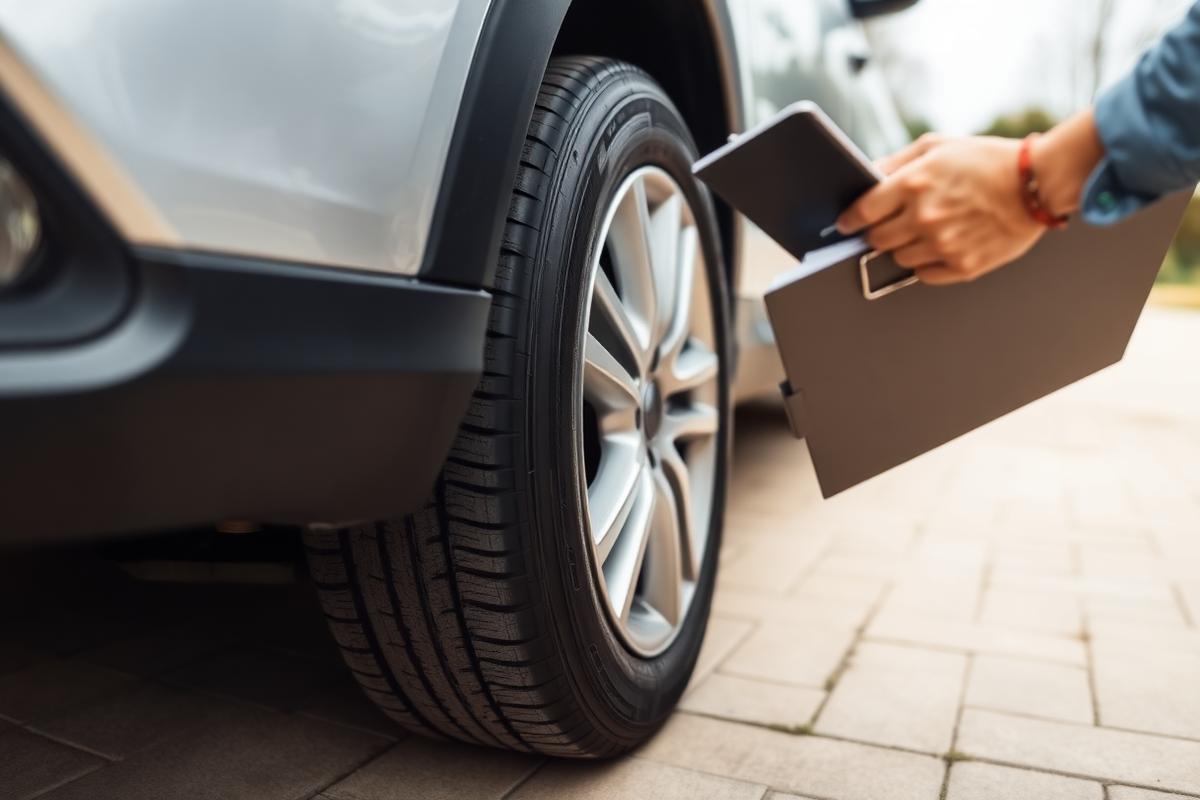
- 16. Tread depth is above the legal minimum of 1.6mm across the central three-quarters of the tyre, on all four wheels.
- 17. Wear is even; edge wear suggests poor tracking, centre wear suggests over-inflation.
- 18. Tyres on the same axle are a matching size and, ideally, the same brand.
- 19. Alloy wheels show the extent of any kerbing damage, which can be used in negotiation.
- 20. A locking wheel-nut key is present — replacements are a genuine cost if it's missing.
- 21. Brake discs don't show a pronounced lip on the outer edge, which indicates they're due for replacement.
- 22. The handbrake holds the car on a slope without excessive travel on the lever or pedal.
Underbonnet — checks 23 to 28
- 23. Oil sits between the MIN and MAX marks and is amber to dark brown — not grey/milky or thick and black.
- 24. Coolant is between MIN and MAX and the colour specified for the model — not rusty brown or oily.
- 25. No fresh weeping or grease around hoses, gaskets or fittings.
- 26. Battery terminals are clean, free of white corrosion, and properly clamped.
- 27. The air filter housing sits square with clips fully engaged.
- 28. The auxiliary belt shows no cracking, glazing or missing sections when viewed from above.
Cabin and electrics — checks 29 to 33
- 29. Every warning light behaves correctly on ignition — a bulb deliberately removed to hide a fault is a serious red flag.
- 30. Air-conditioning produces genuinely cold air within about 90 seconds.
- 31. All windows and any sunroof open and close fully on both sides.
- 32. Seatbelts retract fully on every seat.
- 33. Head restraints, ISOFIX points, the parcel shelf and rear seat folding mechanism are present and working.
Road test — checks 34 to 38
The road test comes last because it draws together everything the earlier checks flagged. Fifteen minutes is a reasonable minimum — long enough to cover cold and warm running, a range of speeds, a firm brake and some cornering under load. A seller who won't allow a proper road test, or who only offers a short loop around the block, is telling you something.
- Cold pull-away and low-speed3
- Acceleration through the gears3
- Sustained higher-speed cruise5
- Braking and steering checks2
- Cornering under load2
- 34. Cold pull-away in first gear is smooth, with no clutch judder or gearbox whine.
- 35. Acceleration through the gears is even, with no flat spot, hesitation or visible smoke.
- 36. A few minutes at a sustained higher speed shows stable temperature and no vibration through the wheel.
- 37. A firm brake on a clear, quiet road shows no pulling to one side and no unusual noise from the pedal.
- 38. Sharp turns under light load produce no clunk from the driveline and no knock from the CV joints on full lock.
Paperwork on the day — checks 39 and 40
- 39. The V5C names the seller at the address you're viewing from, and the MOT and service history are consistent with the mileage shown.
- 40. Both keys, any fobs, the locking wheel-nut key, the service book and owner's manual are physically present before you pay.
Worked example: turning checks into a price adjustment
Suppose a car is advertised at £9,000. During the viewing, tyre tread on the two front tyres measures close to the legal minimum, and one brake disc shows a visible lip. A reasonable, illustrative estimate of the near-term cost is: two tyres at roughly £80 each fitted (£160), plus a front brake disc and pad set at roughly £180 fitted, giving a combined £340. Asking the seller to reflect that in the price — either as a direct reduction or as work carried out before collection — is a normal part of negotiation, and it's worth getting whatever is agreed written on the invoice rather than left as a verbal promise.
What to do if a check fails
Most used cars will fail a handful of these forty checks — that's normal for a vehicle that isn't brand new. What matters is which checks fail. Anything safety-critical — brakes, seatbelts, structural rust, or a paperwork mismatch you can't get a straight answer on — is a reasonable basis for walking away rather than negotiating. Cosmetic issues and wear items approaching replacement are usually negotiation points rather than reasons to abandon the purchase. If in doubt about the seller's honesty over the vehicle's history or ownership, the Citizens Advice consumer service sets out your rights when buying a used car, and Action Fraud is the place to report suspected vehicle fraud, including cloned plates or cars sold with undisclosed outstanding finance.
Checking the legal basics before you commit
The Consumer Rights Act 2015 sets out that goods sold to a consumer, including used cars sold by a trader, must be of satisfactory quality, fit for purpose and as described — the full text is on legislation.gov.uk. Buying privately from another individual falls outside most of those protections, which is one reason the viewing checklist matters more, not less, for a private sale. Whichever route you're buying through, keep a written record of what you checked, what the seller told you, and any price adjustment you agreed, in case a dispute arises later.
The bottom line
The value in this checklist isn't any single item on it — it's running the whole sequence, in order, every time, rather than trusting your instinct on the day. A cold start, an honest look at the panels and tyres, a proper road test, and a careful read of the paperwork will catch the overwhelming majority of problems that would otherwise only show up after you've paid. Building that into a habit costs you half an hour per car and can save you a meaningful amount over the small number of used cars most people buy in a lifetime.
Sources
- gov.uk · Check the MOT history of a vehicle · 28 September 2026
- gov.uk · Check a vehicle's recall status · 28 September 2026
- gov.uk · Vehicle enquiry service (DVLA) · 28 September 2026
- legislation.gov.uk · Consumer Rights Act 2015 · 28 September 2026
- Citizens Advice · Buying a used car · 28 September 2026
- Action Fraud · Report vehicle and vehicle finance fraud · 28 September 2026
Common questions
How long does a proper viewing take?
Around 25–30 minutes for the full sequence, including at least 15 minutes of road testing. Cutting the road test or paperwork checks short reduces how much useful information you actually get.What if the seller won't let me do the checks?
Treat it as a signal. A seller confident in the car's condition has little reason to refuse a cold start, a full road test, or a chance to check the V5C and MOT history properly.Do I need special tools to do this properly?
No. A torch, a tyre-tread gauge or a 20p coin, and your phone to check MOT history on gov.uk before you travel are enough for most of the checks in this list.Should I still get an independent inspection?
It's a reasonable extra step, particularly for a higher-value car or one bought unseen at auction. It doesn't replace doing your own checks in person, but it can catch things a visual check can't, such as hidden accident damage.What should I do if the V5C details don't match the seller?
Pause the sale and ask direct questions. A mismatch can be innocent, but it can also indicate the car isn't legally the seller's to sell, or that it's subject to outstanding finance. If you suspect fraud, Action Fraud is the reporting route.Does this checklist apply the same way at a dealership?
Mostly, yes. A dealership is more likely to have completed obvious repairs before sale, but the same cold-start, road-test and paperwork checks are still worth running rather than assuming they've already been done properly.
Check what you'd be offered.
Real people, straight answers. Talk to us before you apply if you want to.
People also ask
How long does buying a car in the UK actually take?
From opening a shortlist to driving the car home, 2 to 6 weeks is typical. A used-car purchase with an existing soft-search quote can be done in 48 hours; a bespoke new-car order from a factory sometimes takes 3 to 6 months.
Is buying privately worth the saving?
Only if you accept the loss of consumer protection and the near-total loss of finance options. On a mainstream car, the private-sale saving is often absorbed by the higher risk of undisclosed faults and the difficulty of financing the purchase.
Is a private car sale legally binding once I've paid?
Yes. There is no statutory cooling-off period for a private car sale, because no regulated credit agreement is involved when cash or a bank transfer changes hands directly between buyer and seller. Once payment has been made and the V5C signed over, the sale is final in normal circumstances.
From Buying a car privately in the UK — price, risk and finance
What happens if the car I bought privately has outstanding finance on it?
The finance company can usually still recover the car, even from a buyer who paid in good faith, because the lender retains an interest in the vehicle until the previous owner's agreement is settled. Your claim would then be against the seller, which is only useful if they can be traced. A paid history check before paying is the main safeguard.
From Buying a car privately in the UK — price, risk and finance
Related reading

Buying a car in the UK — the complete 2026 journey
How to buy a car in the UK end-to-end: budget, product, sourcing, viewing, checks, negotiation, paperwork, delivery and the first 30 days.
Buying a car privately in the UK — price, risk and finance
Private car sales can be cheaper but carry no Consumer Rights Act cover. What to check, how finance works, and how to avoid common scams.
Buying from an independent dealer — what to check first
How independent used-car dealers price, warranty and finance cars, plus the checks that separate a good forecourt from a risky one.